
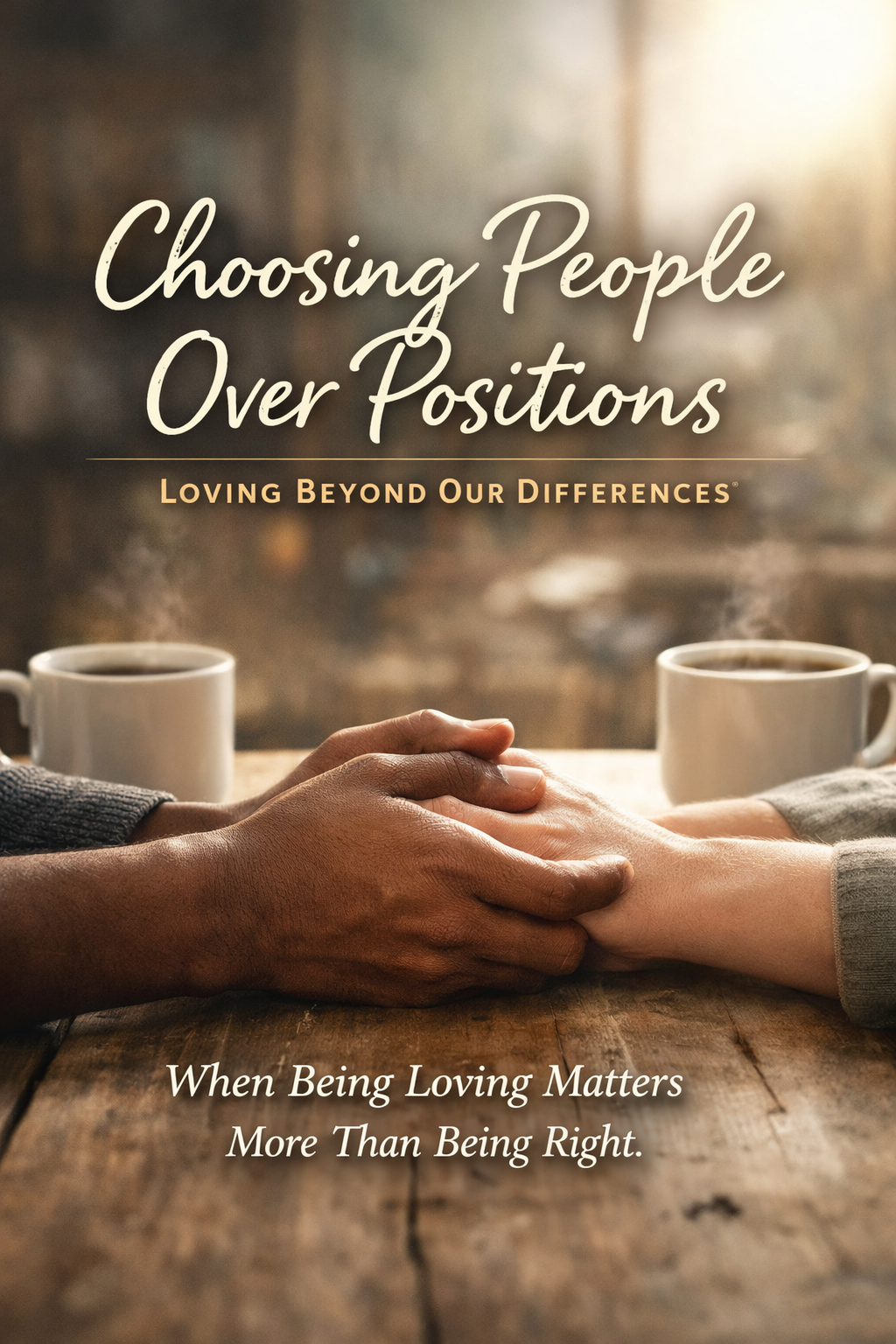
Choosing People Over Positions
In January, we showed why connection is needed: we live in a world that feels ready to ignite — polarized in opinion, quick to escalate, and eager to defend rather than listen.
We don’t just disagree anymore.
We categorize.
We defend.
We attack.
We disconnect.
Often, without realizing it, we stop relating to people and start reacting to positions. That is exactly where love becomes difficult — and necessary. Whether family, friend, or stranger, what our world most needs is not agreement but love: civility, respect, and the costly choice to keep another person human.
This month, we begin a series showing how connection survives disagreement — by living-connected through the Fruit of the Spirit…Love, Joy, Peace, Patience, Kindness, Goodness, Faithfulness, Gentleness, and Self-Control (Galatians 5:22). The fruit is the means; living-connected is the path.
Beginning with love, Jesus sums it up by telling us that the two greatest commandments are to love God and to love others. All other laws depend on these two. (Matthew 22:37-40)
The Apostle Paul clarifies what love looks like in this context: Love is patient, and kind…It does not dishonor others, it is not self-seeking, it is not easily angered, and it keeps no record of wrongs. (1 Corinthians 13:4-5)
When Love Replaces Winning
Not long ago, I found myself in a conversation with my spouse, and I could feel the tension tightening by the minute.
Nothing explosive. No raised voices — yet.
Just two people who cared for each other, seeing something important very differently.
At first, I listened. Then I clarified. Then I explained.
But somewhere along the way, my aim changed. I stopped trying to understand and started needing her to agree. I began anticipating her words instead of hearing them. Her sentences became obstacles rather than thoughts to receive. My frustration rose, and my tone revealed it.
In that moment, I realized I had replaced the person I love with a viewpoint I needed to win. Our relationship began to disconnect right in front of me.
The Moment I Noticed
That realization checked my spirit.
I was trying to win a disagreement instead of loving a person — so I changed one thing: my intention. Not my conviction. Not my belief. My posture.
I chose to love her more than I needed to be right.
With a different tone, I started asking questions I didn’t already have answers for:
“Help me understand what matters most to you about this.”
“What would you want me to understand even if I never agree?”
“Why is this so important to you?”
The conversation softened. She felt heard, understood, and valued. We still disagreed — but we were no longer opponents.
What Love Actually Is
We often mistake love for agreement. It isn’t.
Love is a commitment to make another person feel understood and valuable.
My beliefs rarely are the problem — my posture is. I can say the exact same truth in a way that closes a person or opens them.
When I try to win, they defend, and the temperature rises.
When I try to care, they listen, and the temperature falls.
Words matter less than whether someone feels loved while hearing them. Truth stays the same — the way I convey it changes everything.
Why This Matters
Many conflicts persist not because the issues are unclear, but because love is missing. When people feel dismissed or unheard, they dig in. When they feel heard and seen, defenses drop and connection returns.
Love doesn’t guarantee agreement. But it makes understanding possible — and understanding makes peace possible. When someone feels more important than the issue between you, it becomes possible to navigate polarized opinions, beliefs, and ideologies together.
Monthly Challenge
Choose one person you feel distant from this month — someone you disagree with, someone you avoid, someone who frustrates you.
Don’t approach them to correct or persuade. Approach them in love to make them feel heard. Not necessarily agreed with, but heard and valued.
Be present. Be curious. Ask questions with the intent to listen. Acknowledge their viewpoint. Listen longer than feels needed. Protect the relationship more than your argument.
Let love do its work. Often, the most connecting, peace-giving thing we can do is refuse to win the moment in order to keep the relationship
Living connected in a way that heals is caring less about proving a point and more about helping a person know they are still loved and valued when we disagree.
Reflection Questions
- When I disagree with someone, do I still treat them with love?
- Do I listen to understand or listen to respond?
- Is my tone loving even when my conviction is strong?
- Have I avoided someone instead of engaging them with love?
- Where might God be inviting me to choose relationship over being right?