
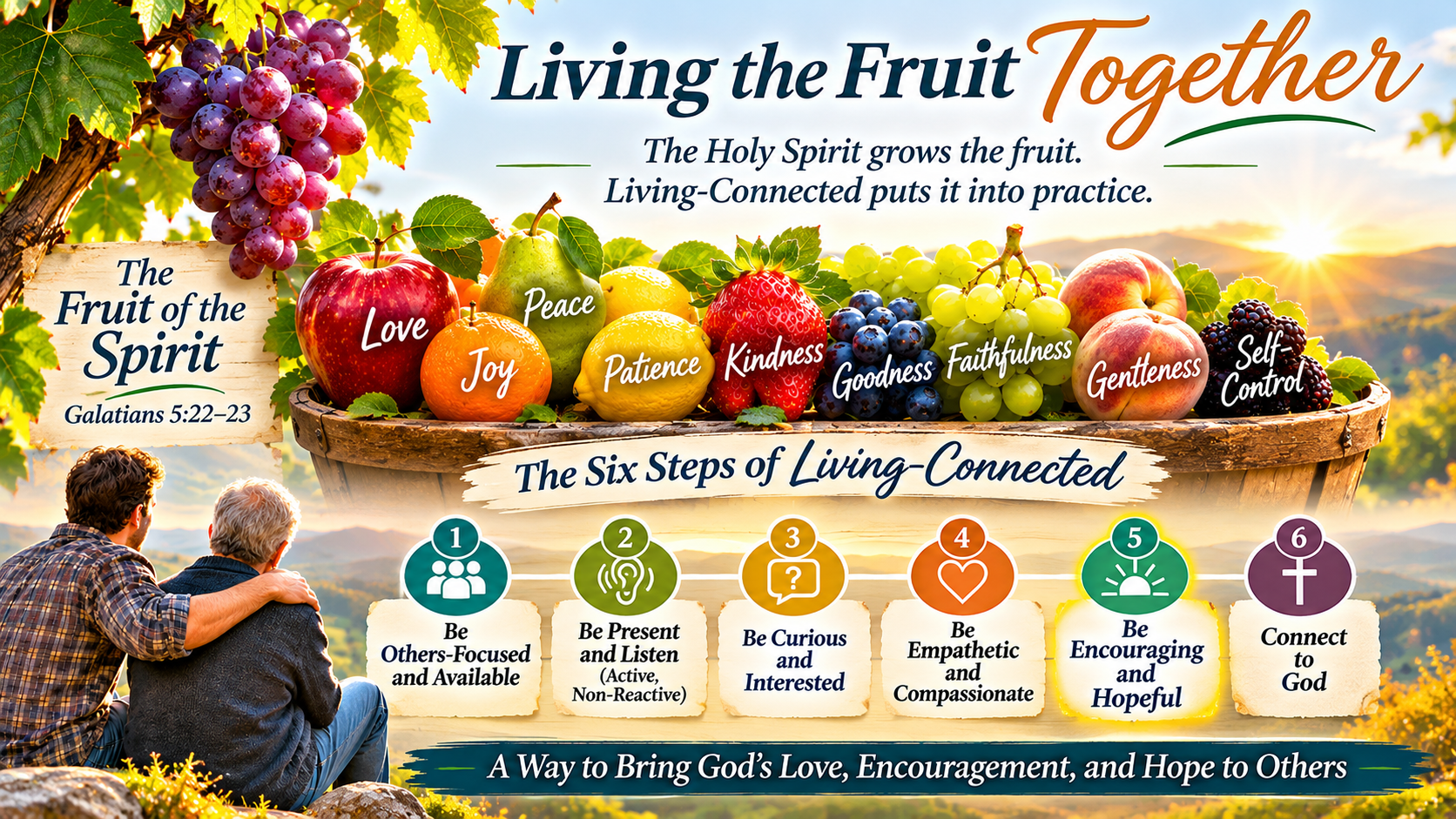
November — Fruit of the Spirit Series Finale
“But the fruit of the Spirit is love, joy, peace, forbearance, kindness, goodness, faithfulness, gentleness and self-control.” — Galatians 5:22–23 (NIV)
Throughout this year, we’ve been exploring the Fruit of the Spirit and what it looks like when the Holy Spirit is at work in our lives.
We’ve talked about love, joy, peace, patience, kindness, goodness, faithfulness, gentleness, and self-control. Each one reveals something beautiful about God’s character and the kind of people He wants us to become.
But there is something important we don’t want to miss as we bring this series to a close.
The Fruit of the Spirit isn’t just about who we are becoming. It’s also about how others experience God’s love through us.
After all, fruit isn’t produced for the tree’s benefit. It nourishes others.
And perhaps nowhere is that more important than when we encounter someone who is hurting, discouraged, lonely, overwhelmed, or struggling to find hope.
When Someone Needs More Than Words
Have you ever been with someone who was hurting and found yourself searching for the right words?
Maybe their marriage is falling apart. They’ve lost someone they love. They’re struggling with a physical illness, facing an uncertain future, or carrying a burden you can’t begin to understand.
You care about them. You want to help. You want to encourage them.
But what do you say? What do you do?
Sometimes our first instinct is to offer advice, explain why something happened, share a Bible verse, or remind them that God is in control.
Those responses may come from sincere hearts. But they aren’t always what a hurting person needs at that moment.
Listen to the heartbreaking words of David:
“Scorn has broken my heart and has left me helpless; I looked for sympathy, but there was none, for comforters, but I found none.” — Psalm 69:20 (NIV)
Imagine that.
David wasn’t simply describing his suffering. He was describing the additional pain of having no one come alongside him in it.
He looked for sympathy. He looked for comfort. He found neither.
We believe those words describe one of the great opportunities God gives us as followers of Christ.
We can become the people someone finds when they are looking for sympathy, comfort, encouragement, and hope.
But how?
Over the last nine months, we tried to answer this question, illustrating how the Holy Spirit can work through the Six-Steps of living-connected.
Think about how the Fruit of the Spirit changes the way we respond to someone who is hurting.
Love moves us toward them instead of allowing us to look the other way.
Joy allows us to carry a deep confidence in God’s goodness, even when the circumstances around us are painful.
Peace helps us remain calm and present when someone else’s world feels like it is falling apart.
Patience gives someone the freedom to share their story without being rushed toward a solution.
Kindness makes our words and actions gentle, thoughtful, and considerate.
Goodness moves us beyond good intentions to do what is genuinely helpful.
Faithfulness keeps us showing up, even when someone’s pain doesn’t go away quickly.
Gentleness helps us respond to their vulnerability without judgment, criticism, or harshness.
Self-control allows us to restrain our impulse to interrupt, correct, advise, defend, or make the conversation about ourselves.
Do you see how beautifully these qualities work together?
They aren’t nine independent behaviors we are supposed to check off a list.
They are the character of Christ being formed in us through the Holy Spirit, enabling us to love others the way He loves us.
And that brings us to the heart of Living-Connected.
Living-Connected Is Love Put Into Practice
At Live-Connected Ministries, we’ve developed Six Steps of Living-Connected to help ordinary people connect with hurting people in a way that heals.
They are simple, but they aren’t always easy.
- Be Others-Focused and Available
- Be Present and Listen (Active, Non-Reactive)
- Be Curious and Interested
- Be Empathetic and Compassionate
- Be Encouraging and Hopeful
- Connect to God
These steps aren’t a formula for fixing someone. They are a practical way to mourn with those who mourn and comfort others as we have been comforted. These steps guide us to become more attentive, compassionate, and responsive to what another person needs.
And the Holy Spirit is essential to every step.
He transforms our hearts so that being others-focused becomes more natural than being self-focused. He helps us listen instead of react, become curious instead of judgmental, and respond with compassion instead of rushing to fix things.
As we practice these steps, the Fruit of the Spirit becomes something others can actually experience.
And that prepares the way for something especially important.
Hope
Hope Doesn’t Begin With an Answer
Step 5 of Living-Connected is to Be Encouraging and Hopeful.
We believe this is one of the most meaningful gifts we can offer someone who is suffering.
But encouragement is often misunderstood.
We tend to think encouraging someone means cheering them up, helping them look on the bright side, or reminding them that everything will eventually work out.
Sometimes we even offer promises God hasn’t made.
“Everything happens for a reason.”
“God won’t give you more than you can handle.”
“I’m sure things will get better soon.”
We may mean well, but these statements can unintentionally minimize someone’s suffering or leave them feeling that we haven’t really understood their pain.
Christian hope is something much deeper.
Hope doesn’t require us to explain someone’s suffering or promise a particular outcome. It allows us to trust God’s goodness, presence, and faithfulness even when we don’t understand what He is doing.
And sometimes the most encouraging thing we can do is simply communicate:
“I don’t understand why this is happening, and I won’t pretend it’s easy. But I care about you, and you don’t have to face it alone.”
Think about what that means to someone who has been carrying their pain in silence.
They have been heard.
Their suffering has been acknowledged.
Someone cares enough to stay.
Their circumstances may not have changed, but something in their experience has.
They are no longer carrying the burden entirely alone.
And that can become the beginning of hope.
The Holy Spirit Is the Source of Our Hope
Romans 15:13 gives us a beautiful picture of where genuine hope comes from:
“May the God of hope fill you with all joy and peace as you trust in him, so that you may overflow with hope by the power of the Holy Spirit.” — Romans 15:13 (NIV)
Notice that Paul doesn’t tell us to manufacture hope through positive thinking.
He tells us that God is the source of hope, and the Holy Spirit gives us the power to overflow with it.
That word overflow is especially meaningful. When something overflows, it doesn’t remain contained. It reaches beyond itself.
As God’s Spirit fills us with His love, peace, patience, kindness, and all the other qualities we’ve studied, those qualities begin to overflow into our relationships.
We become people who bring calm into anxious moments, compassion into suffering, faithfulness into loneliness, and encouragement into discouragement.
Not because we have all the answers.
Not because we can make someone’s pain disappear.
But because the Holy Spirit is at work in us, enabling us to offer God’s love in ways another person can experience.
And sometimes, through that love, someone begins to see a possibility they couldn’t see before.
That is encouragement rooted in hope.
Hope Grows Through Relationships
We have learned that some of the most meaningful connections don’t happen in one conversation. Sometimes we meet someone in the middle of a difficult season, and all they are ready to do is talk.
They don’t need a lesson.
They don’t need our advice.
They need someone willing to listen.
Later, there may be another conversation. Perhaps another question. An opportunity to encourage them, share what God has done in our own lives, or gently explore where they are finding strength.
As trust grows, there may be an opportunity to pray together or connect their circumstances to God’s promises and presence.
But we don’t have to rush.
The goal is not to move someone through all Six Steps. The goal is to love them well, allowing the Holy Spirit to guide us according to their needs and readiness.
This is especially important in our closest relationships.
In marriage, in families, among friends, and even in brief encounters with strangers, we have daily opportunities to either move toward someone or move away.
We can react defensively or listen patiently.
We can dismiss someone’s feelings or become curious about what they are experiencing.
We can criticize, judge, withdraw, or remain present.
We can focus on what we want from the relationship or ask what love requires of us in that moment.
These seemingly small choices matter.
Over time, they help create relationships where people feel safe enough to be honest, where burdens can be shared, and where encouragement becomes more than a kind word.
It becomes a way of life.
We Don’t Have to Be the Source of Someone’s Hope
There is one more important distinction.
We are not anyone’s savior.
We cannot heal every wound, solve every problem, restore every relationship, or explain every hardship.
And God has never asked us to.
Our calling is to love others faithfully and point them toward the One who can provide what we cannot.
Jesus promised His followers that the Holy Spirit would be with them and in them (John 14:16–17).
That same Spirit continues His work in believers today. He gives us wisdom when we don’t know what to say, patience when listening is difficult, compassion when someone’s suffering is overwhelming, and courage when we are afraid of getting involved.
And He reminds us that the outcome does not depend on us.
Our responsibility is to be available, loving, and faithful. We can trust the Holy Spirit with the work only He can do.
That frees us from the pressure of having to fix someone. Instead, we can focus on being present with them and helping them discover the hope that is found in Christ.
Living the Fruit Together
As we conclude this series, perhaps the most important question isn’t how much we’ve learned about the Fruit of the Spirit. It’s how much our relationships are changing because of it.
Are we becoming more patient with the people we love?
Are we more willing to listen to someone whose pain makes us uncomfortable?
Are we less defensive and more compassionate?
Do people experience kindness, gentleness, and faithfulness when they are with us?
And when someone is discouraged or hurting, do our words and actions help them experience hope?
We won’t always get it right.
We will still interrupt, react, grow impatient, miss opportunities, and sometimes say things we wish we hadn’t.
But spiritual growth isn’t about perfection. It’s about allowing the Holy Spirit to continually transform us into people who increasingly reflect Christ’s character.
The Fruit of the Spirit describes who we are becoming. The Six Steps of Living-Connected help us put that transformation into practice. And the Holy Spirit makes both possible.
So as we move toward the end of another year, let’s look for the people God places in our path.
Someone who needs to be noticed.
Someone who needs to be heard.
Someone who needs compassion rather than criticism.
Someone who needs encouragement rather than another explanation.
Someone who needs hope.
Because when we live the Fruit of the Spirit together, something wonderful happens.
God’s love doesn’t stop with us. It flows through us to someone who needs it.
And perhaps, when someone like David looks for sympathy and comfort, they will find it.
They will find someone willing to move toward them, listen to their story, carry a little of their burden, and gently remind them that hope is still possible.
What a beautiful way to live.
And what a wonderful way to reflect the love of Christ.
A Final Invitation
This week, ask the Holy Spirit to help you notice one person who may be carrying a burden you cannot see.
Instead of asking yourself, “What should I say?” try asking:
“Lord, how can I love this person well today?”
Then be available. Listen. Be curious. Show compassion. Offer encouragement when they’re ready. And look for opportunities to connect them with the God of hope.
You don’t have to have the perfect words.
You simply have to be willing to move toward someone and allow the Holy Spirit to work through you.
Live-Connected Ministries
Equipping ordinary people to connect with hurting people in a way that heals.